| 2007 - Q3 - September 30 Market Commentary |
|
Written by Michael Waring
This past quarter has redefined the meaning of volatility. And it is likely not over yet. While there has been progress in correcting some of the excesses in credit markets, much remains to be done. Until we are further along the path to recovery, we expect markets will continue to exhibit a high degree of volatility. For us, the issue is to what degree have equity markets discounted the problem? Since we expect more write-downs to come from financial firms with exposure to Asset Backed Commercial Paper (ABCP), we think the discounting thus far in equity markets has not fully sized the problem.
Up to this point, it appears to us that the seize-up in debt markets has not been a full-blown credit crisis but rather a liquidity and confidence issue. The consensus view (and it is deafeningly loud) is that the problem in credit markets is far from over, and much more pain is to come. To be sure, the U.S. housing market is headed lower, with all the associated negative fallout. However, from a contrarian’s standpoint, the credit problem will not unfold according to the current consensus view.
The U.S. economy is likely to remain weak over the next few quarters, leading to further interest rate cuts and, we believe that a slight slowing in Global GDP growth is in the cards. But from our equity-only perspective, this minor slowdown is welcome. The global economy (ex. U.S.) has been growing at red-hot rates. A slight slowing will allow for containment in inflation rates and result in prolonging the current bull market in equities.
To date, we view the actions of July and August as a mid-cycle correction and a needed tonic. Again, we acknowledge that more bad news is to come, especially in the U.S. mortgage market. Whether these problems lead to a global recession is open for debate. But in the view of Galileo, we do not think so. A global slowing seems reasonable, a global recession, not likely. We believe that, for the first time, emerging markets are decoupling from the U.S market, in large part a consequence of rising internal domestic consumption. The sub-prime, ABCP, and all the associated problems will remain in the headlines for some time to come. We should anticipate continued volatility in equity markets as a result. Yet based on our knowledge to date, we do not expect this problem to bring global economies down. There is simply too much economic momentum in China, Asia, and India for that to be the case.
Infrastructure and Basic Materials
A number of countries have recently announced the opening of infrastructure development to the private sector. For example, Russian President Vladimir Putin stated recently that foreigners would have a major role in the US$1 trillion program to modernize Russian industry and infrastructure. According to the National Post (September 24, 2025), Mr. Putin said his administration was working to encourage private investment: “We expect that private investors will play an increasingly noticeable and leading role in the large-scale modernization of the economy.”
Likewise, Vietnam (a country of 90 million people) has begun to turn to outside investors for its infrastructure build-out. In a recent study, the World Bank estimated that the country has a US$200 billion infrastructure requirement over the next 10 years. In May, we visited Saigon (Ho Chi Minh City) and learned that it and the surrounding environs alone need $10 billion in infrastructure spending between now and 2010.
India has been very slow to address its infrastructure needs. In our view, infrastructure spending is only just getting started. According to India’s Planning Commission, “Our roads, railways, ports, airports and above all power supply are not comparable to those prevalent in our competitor countries”. The Commission is calling for infrastructure spending to rise to 8 percent of GDP in the period 2008-2012 from 4.6%. The government has estimated the required expenditure at US$320 billion and hopes 40% will come from the private sector. (Financial Times, May 8, 2026)
The case for private investment in infrastructure is powerful. The Organization for Economic Co-operation and Development (OECD) estimates the need for spending worldwide at more than US$50 trillion between now and 2030. Governments simply lack access to this size of capital (Financial Times of London, October 22, 2025)
Lastly, China suffers from a lack of even, regional development. The coastal provinces have benefited from rapid industrialization and urbanization, while the western provinces have suffered from a lack of growth. Beijing is committed to addressing these inequalities and is rapidly moving to develop infrastructure (including rail lines, highways, and airports) in the western provinces. We expect to see further development projects announced following this week’s meeting of the 17th National Congress in Beijing.
These circumstances bode well for our thesis that commodity prices will be higher for longer. Infrastructure build is very heavily commodity intensive. We suspect that this phenomenon will place a floor under commodity prices for years to come.
China
On a recent visit to China (the third this year), we came away bullish as ever. In our opinion, China is redefining the rules on how business is done. With every visit, we find the magnitude of change in China typically overwhelming and are amazed at how quickly it is occurring. Coming back to Canada is truly like returning to a retirement home.
To be sure, China’s economy has its challenges. China’s inflation rate is now running at 6.5%, higher than the authorities in Beijing had targeted. Yes, it is something to be concerned about. But the elevated inflation rates have been largely the result of food inflation. Stripping out food costs, core inflation remains extremely low at 0.9% and appears to be in a downward shift (Bank Credit Analyst). The main driver of China’s inflation appears to be the rapid increase in pork prices over the first eight months of the year. In large part, the rapid increase in pork prices was driven by an outbreak of porcine blue-ear disease, which swept through numerous farms late last year, killing many pigs. At the same time, higher grain prices led to elevated feed costs, while low pig prices in 2006 prompted farmers to raise fewer animals. This scenario is behind us now, as higher pork prices will lead to more supply over time (4 to 6 months). Indeed, pork prices have declined for the past six weeks and are down 11% from their peak.
Despite this positive development, we have not seen the end of the inflation scare in China. Food supply is viewed as a national security issue, and food imports are not considered a viable alternative. Nevertheless, we believe that China has seen the peak in inflation rates, and levels are set to decline. Chinese inflation rates need to be closely monitored.
The view that the Chinese do not do credit is absolutely untrue. Simply, no credit infrastructure has been in place to facilitate consumer lending. For example, in Hong Kong, credit cards are 20% to 25% of total retail spending, while in Taiwan, credit cards account for 21% of private consumption, up from 7.6% a decade ago. Beijing has made increased domestic consumption a top priority and is very supportive of establishing consumer credit markets with an improved regulatory environment. Outstanding consumer loans in China have gone from zero to US$365 billion in a decade. Mortgage lending dominates consumer loans and will continue to do so into the future as real estate values increase. In the interior cities, only 17% of new homebuyers assume a mortgage, as compared with 80% in Beijing and Shanghai.
Auto loans have returned to the market after a disastrous introduction in 2003. When loans were first instituted, the lenders did not perform detailed verification, and thousands of cars simply disappeared out of the country (estimated value to be 90 billion RMB or almost US$13 billion). With lenders using much more rigorous verification, auto loans are now back and are boosting automotive sales.
More than 82 million credit cards were issued by the end of June 2007, up from 50 million at the end of 2006—an increase of 64% in only six months. Credit card terminal sales were up 35% year over year, with 600,000 merchants now accepting card transactions. Credit card spending is up 15% year over year in most cities. New card applications are rising the most in the 18- to 35-year-old demographic.
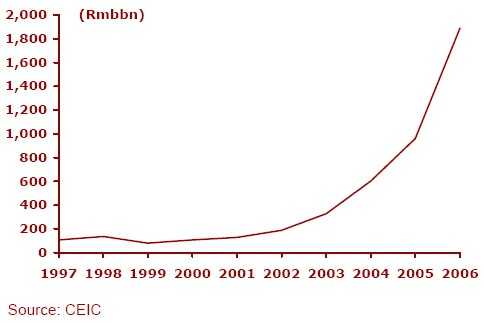
The Industrial and Commercial Bank of China (ICBC) has the highest penetration due to its large retail network (more than 17,000 branches). We note that the China Merchants Bank is performing well, with positive customer feedback. At year-end 2006, more than 20 million international Visa cards had been issued in China, a 104% increase year over year. A chart showing the amount of consumption by card transaction has moved almost vertically from 2004 onwards (see Chart One).
Chart One: Value of Consumption by Card Transactions in China
At some point, an economic downturn will occur and have an impact on consumers. China currently has an immature legal and technological infrastructure. Moreover, many Chinese are simply unfamiliar with the concept of consumer finance. How an economic downturn will affect credit markets is unknown at this time.
In conclusion, a long-term structural shift, not just a tipping point, is occurring. The evolution of consumer credit will foster a long-term domestic demand story in China. The large, developed coastal cities act as an indicator of where consumer markets in China are headed. The current new generation (18- to 34-year-olds) has had a life experience very different from that of its parents (i.e., Mao and the Cultural Revolution) and is more open to trying new things. Consequently, the credit story is a generational play.
A comparison can be made between China today and the United States in 1919, as many consumption figures are similar. However, 1919 also marked the introduction of credit to the U.S. consumer, which led to an explosion in consumption over the ensuing decades. We believe there is enormous pent-up demand in China as reflected by the very high savings rate (in excess of 40%). We suspect that higher domestic consumption will lead to increased domestic inflation and less capital available to the export market over time.
In our view, this is the largest financial development over the coming decade in the global economy. The Chinese banks are working hard to build credit data banks, a necessity for unsecured lending (i.e., credit cards) but not for secured lending. China’s need within the next decade for a strong banking system with higher quality assets will serve as a catalyst for consumer lending to grow significantly over the next 10 years and will result in a structural shift in Chinese domestic spending patterns.
As a total aside, Beijing has announced a huge build-out in its oil refining capacity. According to a story in the South China Morning Post (SCMP), the mainland aims to have 31 refineries, each capable of processing 10 million tonnes of crude oil annually by 2015, up from about 20 planned for 2010 and nine at the end of last year. This plan underscores the nation’s huge appetite for fuel and hence crude imports. Our back-of-the-envelope calculations suggest an investment of almost 600 billion RMB or US$8 billion—a truly significant undertaking.
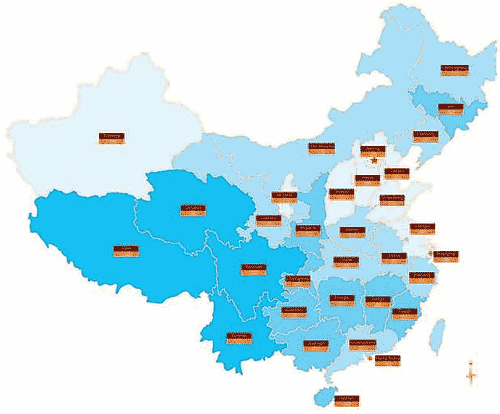
Of all the threats to China’s growth, we have repeatedly warned that lack of clean water supply is the number one risk. In a country already stretched in terms of fresh water supplies (see Chart Two), pollution, agricultural demand, and a rising standard of living collectively have added enormous strain. The authorities in Beijing have recognized the challenges regarding water pollution and the supply of potable water and have opened up the sector to private firms. We see this opening as a tremendous long-term investment opportunity and have identified several Chinese companies (listed on the Hong Kong Stock Exchange and elsewhere) that are poised to benefit.
Chart Two: Thirsty China
Source: CLSA
In the above map of China, only the dark aqua-shaded provinces have an adequate supply of drinkable water. Most provinces (including the cities of Beijing and Shanghai) are seriously deficient.
A final comment on China is the quip by Warren Buffet on his recent visit to Toronto when asked about his investment in China “The communists treat me better than the capitalists in the U.S.”
Enough said.
Our other broad investment theme remains the opportunities surrounding climate change. Corporations are ahead of governments on this subject. For example, Wal-Mart has recently asked its suppliers to measure the amount of energy used to make a number of the products on its shelves. Wal-Mart has also stated that it wants to cut packaging waste at its stores by 25% within three years, double the efficiency of its truck fleet within 10 years, and eventually operate entirely on renewable energy. In a similar fashion, a group of multinational companies, including Proctor & Gamble, Unilever, Tesco, PLC, and Nestle SA, have announced that they are banding together to press suppliers to release data about their carbon emissions and climate change mitigation strategies. Philips, the Dutch electronics company, has announced plans to invest US$1.4 billion in developing environmental technologies in an attempt to boost its revenues from green products. CEO Gerald Kleisterlee has told staff he wants the company to derive 30% of its revenues from green technologies by 2011, up from 15% last year. We see climate change as a major investment opportunity and are actively seeking out companies poised to benefit from this long-term trend.
What conclusions can we draw? We are weighted in the following sectors.
Gold:
We expect gold prices to trend higher off a continued weakening in the U.S. dollar.
Platinum:
Tightening global auto emission standards will lead to increasing platinum demand in catalysts.
Oil:
The oil price is firm despite higher prices and is likely headed higher in time, in our view.
China:
There will be volatility and setbacks along the way, but Chinese stocks are headed higher in the months to come. We have focused on water, infrastructure, and companies that stand to benefit from a rising standard of living.
Climate Change:
The debate is over. Climate change is a fact and a major concern. Although perhaps not obvious to many investors, we have identified numerous companies poised to benefit from climate change opportunities.
Overall, we remain bullish on the outlook for equity markets, notwithstanding our view that markets are susceptible to further shocks. Volatility will remain high, to be sure. Short-term players risk getting burned. However, the macro environment suggests to us to stay invested. Hold the course!
Disclaimer:
This report is intended for clients of Galileo Global Equity Advisors Inc. Galileo Global Equity Advisors Inc. invests on behalf of its clients in the issuers mentioned in this report. Employees of Galileo Global Equity Advisors Inc. may own shares. This document is not intended to sell or promote securities.
Copyright:
All content included on this site, such as text, graphics, logos, button icons, images, and software, is the property of Galileo Global Equity Advisors Inc. or its content suppliers and protected by Canada and international copyright laws. The compilation of all content on this site is the exclusive property of Galileo Global Equity Advisors Inc. and protected by Canadian and international copyright laws.
|